Search This Blog

Thursday, October 19, 2017

The Balloon Fiesta - Finally!

Thursday, October 12


Rise and shine.  It is 49 degrees at 5AM, so we wear multiple layers and take a backpack with snacks and water.

The first balloons to inflate and lift off are called the Dawn Patrol, and their jobs are to go up and test wind currents and report.  Albuquerque is in the shadow of the Sandia Mountains, so dawn comes slowly..  Here, the Dawn Patrol is ready to lift off around 6:00.


  All is favorable, so the green flag for “go” is flown.  The next group to inflate and take off are about a dozen that take paying passengers, mainly Rainbow Riders.


The launch field itself is huge (54 football fields) and is organized so that the balloons take off quickly  in waves.  There are many “zebras”,
folks in black and white striped clothing , that direct things.  Very well orchestrated!


People are free to roam the field, watching, cheering and staying out of the balloonists' way. Greg and Gwynne and I all have our phones in case we get separated.


Soon we are in awe as wave after wave take to the air amidst the swooshing sound of the burners.  Then the sun breaks over the Sandia Mountains and brightens the colors for an even more amazing site!  Hundreds of balloons take to the air! 


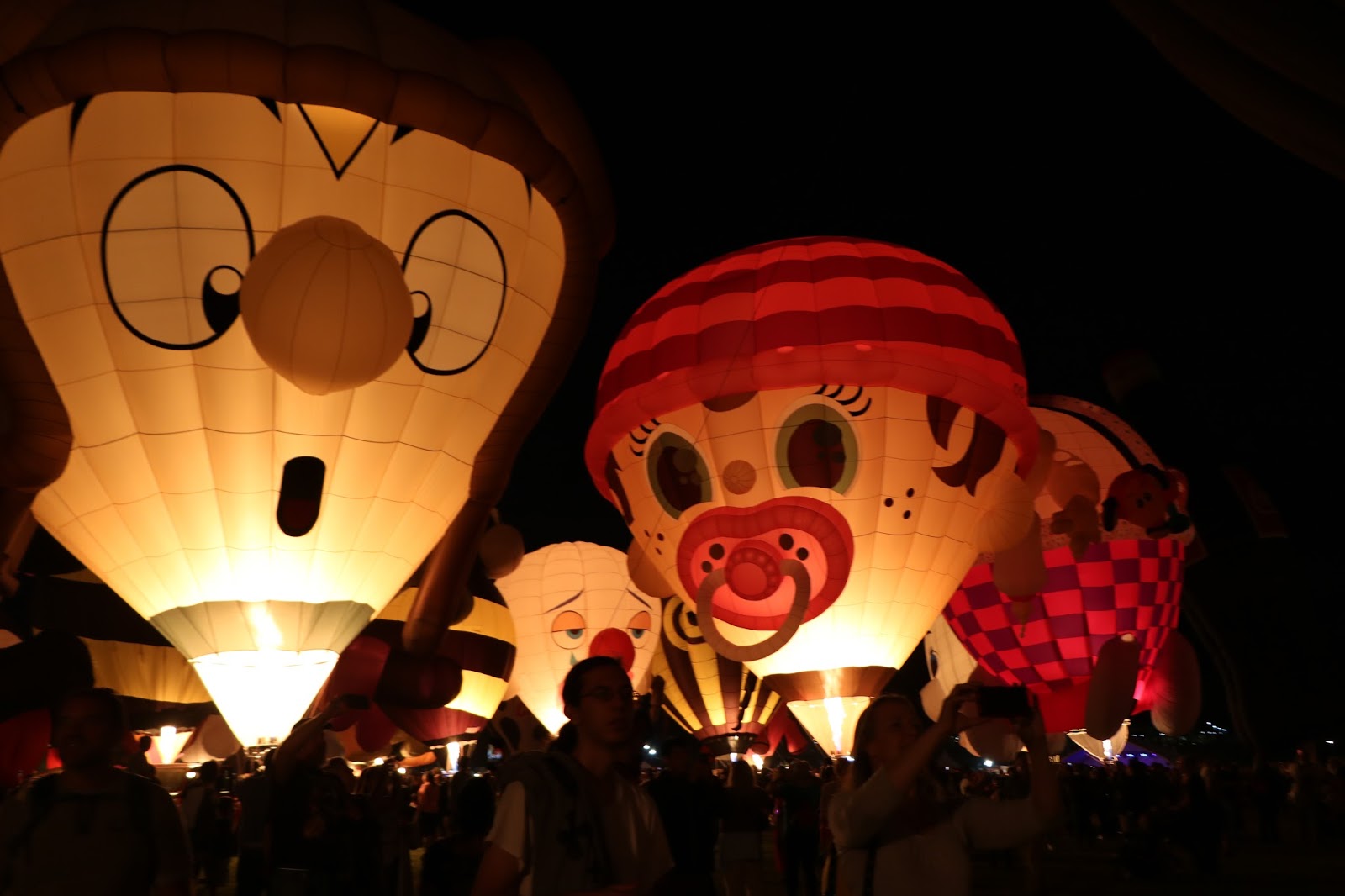
 And then there are the special shape balloons, such as dogs, smokey the bear, chickens, darth vader, baby carriages, a flying pig, a panda, bees, and many more.   The sun also helps with the temperature as we can shed gloves, hats and layers.


Many of the balloons represent companies, some obvious like the bimbo baker below, some subtle.
All during this time, we wander the field, watching some balloons being inflated as others lift off.  Each balloon has a chase crew, which takes off in a vehicle when the balloon lifts off, to be there when it lands.   It is hard to tell from photos, but the balloons are very large – 70-90,000 cubic feet (about 22 elephants worth).  That's quite a lot to manuever and the process to become a pilot is quite lengthy.  There is one year of training, similar to becoming an FAA pilot.  If you want to do it commercially there is another license and more training.  A balloon costs an average of about $80,000.

About 8:45, Beth heads back to the Trek while Greg and Gwynne go to the nearby Balloon Museum.  The first hot air balloon passengers were a duck, sheep and rooster September 19, 1783, sponsored by the King of France.


Bacon, eggs and bananas for breakfast.  We hang out, setting up chairs outside and relax a bit till about 4:00 when we take the shuttle back to the air field to check out the vendors and displays there.   Lots of vendors with warm clothing (must have been popular this morning!), many souvenirs from jewelry to t-shits to artwork, etc. and displays by sponsors Canon, Verizon, Bimbo (bakery) and more.  There is also a chain-saw art display with artists creating some pretty nice work.


Tons of foods too, from the usual corndogs and nachos to some southwestern fare (with red or green chili of course).  We enjoy some ice cream as the day has warmed up nicely, and sit in the field to wait for the evening display. 

As dusk falls, a few hundred of the balloons set up and inflate their balloons but do not lift off, so we can walk amongst them and catch some good photos.  This is called the "Glow".


 Now and then someone will give a countdown from 10 and many balloons will light at once, but generally it is balloons blinking on and off against the night sky.  Beautiful!

As we wait for the shuttle back to the Trek,  they set off a nice fireworks display to cap the evening!   Back at "home", we discover to our chagrin, that the fridge is not working when set on propane, so food is not the coldest. Gwynne comes to the rescue, finding a bag of ice for us.  We distribute the ice, then enjoy some snacks and call it an end to an amazing day!


Cochiti Lake; Tent Rocks Oct 11


Wednesday, October 11

Cochiti Lake is an Army Corps of Engineer Lake with a huge earthen dam.  Pretty in the morning sun.


We decide to head to nearby Tent Rocks National Monument this morning, also known as Kasha-Katuwe, the indian name meaning “white cliffs”.

 After breakfast, we take the slot canyon trail.  Huge cliffs and narrow slot canyons -  amazing what water and wind can create!   Very narrow in spots and the graceful curves where water flowed are quite pronounced!


Beth walks about a mile of the trail and then heads back when it becomes steep climbing.  Greg and Gwynne continue on to a beautiful view from the top, then take the Cave Loop trail to a large cave surrounded by white rock. 

  Several buses of loud, exhuberant teenagers arrive from Albuquerque and we are once again glad to have arrived early as they pass us going in on our way out.

We stop at a Blake's Lotsaburger, a New Mexico chain known for the green chili burgers.  Gwynne tries one (with the chilis on the side).  


Next stop, still heading south toward the
Balloon Fiesta Park, is the Coronado Historic Site.   We have a guide here named Charlie (who is originally from South Philly) who is very respectful and enthusiastic about this site.   This pueblo was inhabited from about 1300 to 1600 and consisted of about 1200 rooms.


In February of 1540, Coronado along with about 300 Spanish soldiers and nearly 1,000 Indian allies and slaves came to this area.  They also brought cattle and horses which were totally new to residents here.  This was the site of the Kuala Pueblo and being near the Rio Grande and not far from the mountains it was a prosperous site.  Unfortunately, Coronado and his entourage needed food and shelter badly and pretty much took what they needed, and left livestock roam, wiping out the Indians food supplies meant to last the Winter.  This led to animosity and violence and the Spanish eventually withdrew, only to return in 1598 as settlers, claiming much of the good land.
 
In 1884, the archeologist Bandelier rediscovered the ruins here. Later, in the 1930’s,   desperate to find an encampment site of Coronado, Bandelier named this as such, though there is little to support the claim.  They didn’t find traces of Coronado, but they did find an amazing square kiva with many murals. The walls had been painted and repainted many times.  Archeologists at the University of New Mexico were able to remove the walls and preserve many of the murals, about a dozen of which are on display in a separate room here at the visitors center (no photos allowed). The kiva itself was restored and we were able to climb a ladder into it. 

The murals there today were duplicates of originals and were done by a native artist.   They include dancers, birds, deer, many symbols for water.  Only men were allowed in the kiva.  There are strict rules about entering the kiva because the murals depict symbols from their history and sacred  ceremonies and no photography is allowed.

There is a reconstructed example of one of the rooms from this pueblo.  Short people! 

Realizing that what was uncovered in the 1930’s was quickly deteriorating, the archeologists re-covered most of the pueblo ruins for posterity, so what is seen now is a footprint of re-constructed adobe  bricks outlining what is below the ground.  Things found on these grounds showed that the residents traded widely, from California to Mexico.  Most of the Indian Pueblos were matriarchal in nature, with the youngest daughter in the family inheriting property. 

Gwynne and I bought some small clay ornaments from a pueblo man who makes them with his wife.  He was eager to explain the symbolism and gave us a card with an email address where we could ask any questions.

We arrive at the Balloon Fiesta RV Campsite around 5:30 PM.  They have been doing this for  many years so signage and organization is good.  There are nearly 1,000 rvs from our tiny one to huge ones with decks on their roofs!  We are in an area adjacent to a small cemetery where there is a row of small vehicles.  At least our neighbors are quiet is the joke! 


Greg grills burgers for dinner and we regroup for tomorrow’s early morning.  There are shuttle buses (converted school buses) to take us to the launch field about a half mile away, which is a great deal because they bypass traffic and avoid the $15 parking fee!  Dawn Patrol begins about 5:45AM tomorrow!  There are no activities tonight. 

Sunday, October 15, 2017

October 9-10 Bandelier/Taos

October 9, Monday


We used the propane furnace last night which made for a comfortable night as temperatures fell to about 40.

We got up with the sunrise and drive to the trailhead for the Main Loop Trail and Bandelier National Monument,  Once there we made blueberry pancakes for breakfast and then set off into Frijoles Canyon.

The remains along this trail were from Tyuonyl Pueblo, which consisted of about 400 rooms in this area. 


The population is estimated to have been 4-500 people. They lived both in cliff dwellings and in structures built in front of the cliffs and nearby.  There are remnants of a large round kiva and many buildings.  Suprisingly, they and other Indians in the area had many domesticated turkeys – some of which were kept in some of the first floor rooms.  They raised corn, beans and squash and also stored these and other foods in some of the small rooms.
We climbed into some of the dwellings which were mostly small.  The rocks are volcanic tuff and rather soft, so some of the natural holes were enlarged.


Bandelier is in a valley with a stream that goes to the Rio Grande River, so while arid, there are quite a few trees.  Cottonwood are a pretty yellow now.  There are also willows and assorted pine including a few Pondersa pines (whose bark smells like Vanilla.) 

    There are a few pictographs.  The dwellings continue along the cliff for quite a ways.  Then we cross the stream and Greg and Gwynne continue on to an area called The Alcove.


This involved climbing many ladders to a cave which was quite large and impressive. What a climb!


Beth took a leisurely walk back to the parking area, spotting a few critters like these:  Abert Squirrel, with tall tufts at his ears,
and a tarantula.  The ranger later said the tarantulas are mating, so are out "looking for love".

It was nice that we arrived early this morning - before the shuttles started arriving,  because things were quite busy by the time we finished.

We watched a short film and looked at displays at the visitors center which was originally a lodge built by the CCC to replace one that had burned earlier. 
This whole area of New Mexico was a mass of volcanoes at one point.

Lunch of pb&J, grapes and chips before  dumping tanks,  refilling water and heading northeast toward Taos.  We saw several mule deer along the road, and later a pair of coyotes. Here's one.

We went through Los Alamos, which is where work on the first atomic bomb took place.  It is still active in nuclear research and experimentation.  Greg had to show an ID to enter the area and "vouch for" Gwynne and I.  Some very nice scenery in the area as we wound in and out of  mountains.


It got progressively colder and cloudier as we approach  Taos.  The Taos Pueblo  closes around 4:00 so we opt to do that first thing tomorrow instead of rushing.  The town seems to be majorly adobe buildings and homes, with many shops and restaurants.  

Beth finds a campsite which is a few miles into the mountains east of Taos, but as we start to gain in elevation we see several vehicles coming our way with more than a dusting of snow on them!  And then the snow flurries start!  Since we aren't really winterized, we turned around and Gwynne gets her first experience of spending the night at Walmart, at a slightly lower elevation.  Cold, but no snow.

First we find a nice restaurant called Casa de Valdez where Gwynne treats us to a lovely dinner.  She and Greg have some excellent ribs, while Beth has chicken.  Yum!  Pretty quiet night.


Tuesday, October 10

This morning we find a McDonalds for coffee and a biscuit before heading to the Taos Pueblo, a UNESCO World Heritage Site. 

We are in the second tour group of the day, about a dozen people led by Ceasario Chavez , a young man who was born and raised here in the Pueblo.  We begin in the church which was built in 1860 and is still used today.

He gives us a short history of the pueblo including domination by the Spanish who insisted the Indians become Christians.  There was a pueblo revolution in 1680 and the Spanish were driven out briefly and Catholicism rejected. There was much violence and death and the old church was destroyed along with many people including women and children who were sheltering there during the Mexican/American war.
 Eventually Catholicism and their own spiritualism were joined – for example, he says the statue of the Virgin Mary is also representative of Mother Earth,

There is no running water or electricity in the Pueblo, though some do use propane.  They carry water from Willow Creek which runs from the nearby mountains.
There were many hornos,  clay ovens, in the area which they use for baking as well as firing pottery. Many homes have fireplaces.
  This Pueblo’s people are known as the Red Willow people and their language is totally oral, passed by word-of-mouth.

Their population is about 2500 and they are a sovereign government with their own security,  courts, etc. including school till 8th grade. (after which they must go to the public school).  There were about 30-40 families within the area visitors are allowed into.  Many areas including some with kivas and homes were off limits.  Their mixed feelings about outside visitors may be reflected by this sign:


The main pueblo building  is over 1,000 years old and is 3 stories
 high. with the entrance on the 3rd floor, then ladders down to first story rooms.  (For security).  Many of the inside walls are painted white to brighten the otherwise pretty dark interiors.  Many of the names in the cemetery are Spanish because of intermarriage.  There are several veterans buried there who were either drafted or enlisted.


  The outside walls are replastered every 3 or 4 years.   They make their own adobe bricks, which include pieces of straw.  Some think that the Spanish thought there was gold in the bricks because of the way the sun  glints off of it.  The doors, which are outlined in bright colors to protect from evil spirits, are relatively new.  Entrance used to be by ladders to the 3rd floor, then ladders down to the other rooms.

The area of the pueblo is mostly dirt and dust with some trees near the water.  There were many dogs wandering around unattended.


After the tour, we were allowed to walk around in the area open to the public.  Many folks had set up shops in some of the dwellings, selling jewelry, drums, pottery and other goods that they make.  Gwynne bought some delicious fresh bread and a lovely necklace.


From here we head south through Carson National Forest, enjoying the scenery and several black and white magpies. 


We are looking for a campsite with showers and find Cochiti Lake a bit south of Sante Fe.    We enjoy the showers, though they could have been hotter, and have kielbassi for dinner and play some Catch-Phrase, a game that was a gift from Julie way back when she was interning downtown and living with us!