Search This Blog

Tuesday, December 6, 2022

October 15, 2022 Dublin and home


 Saturday, October 15

David meets us this morning wearing a shirt with the Irish flag colors - Orange for King William, green for the 50 shades of Ireland, and White for peace. It is meant to symbolize the aspiration for unity between people of different traditions on this island.

Kay is our step-on guide this morning.  We first stop at Merrion Square where there is an interesting statue of Oscar Wilde.  We arrange ourselves for a group picture, which Tommy, our driver snaps for us.


There is a great deal of Georgian architecture, typically 5 story high buildings, in the old part of Dublin.  It has a small city center and people are not allowed to change the exterior of their homes here.  The city is divided by the river Liffey and features 19 bridges. 

 90% of the population is Catholic here and they love their writers - James Joyce, Oscar Wilde, Samuel Beckett, William Butler Yeats, Jonathan Swift, Maeve Binchy and others.  Author Brendan Behan described himself as a drinker with a writing problem and said he only drank two times, once when he was thirsty and the other time when he wasn't.  He died young.

Dubliners are also the greatest tea drinkers in the world.  I must admit that tea and scones yesterday afternoon really were a nice pick-me-up!

At one point Kay quips that the city has wonderful politicians - "the best money can buy".  Another comment about the Irish performer Bono - the difference between Bono and God is that God knows he is not Bono. 


We go by St. Stephen's Green,  a lovely park that began as a public land for grazing sheep.  Lots of greenery and statues.

Above is a statue of founder of the Guiness Brewery, begun in 1759. It produces 4 million pints a day. They employ many (each employee gets 2 free pints a day!)and also support many cultural and civic organizations. We also pass Christ Church, Trinity College and an 800 year old pub.  We make a brief stop at Phoenix Park, a 752 acre park with fields for Rugby, Cricket and Football.  


The American Embassy is located here as well.  A walk through some gardens is abbreviated by rain.

 We end with a tour of St. Patrick's Cathedral, National Cathedral of the Church of Ireland. St Patrick himself baptized people on this site.  The first reference to it is from 890AD. Beautiful!


Below is a covering of an ancient well, located next to the Cathedral.  It may be the well where St. Patrick performed baptisms.


There is not a lot of crime in Dublin, but there are homeless and people are warned about pickpockets in busy areas.   The police are called "Guardians of the Peace" but we don't see any.

There is free time to explore after the tour, but Beth is not feeling great so we chill back at the hotel till the evening Farewell Dinner, enjoying tea in the lobby and a brief walk to a Tesco (convenience store) for tea.

Nice dinner, with each person offering what they liked best about the tour.  David got many well deserved kudos.  Greg mentions the Giant's Causeway and I mention Edinbugh, though after thinking about it more I'd have to say Slea Head was pretty awesome.  We traded email/addresses with some folks and made it an early night since our ride to airport will arrive at 3:30AM.  Clayton and Kathy will share the cab as they begin the trek back to Montana.   

Sunday, October 16

David meets us in the morning with a "to go" breakfast bag.  Our taxi driver has a heavy accent and although he is being quite a pleasant tour guide, we only understand a fraction of what he is saying.


Although our reservations said Delta, we are actually flying KLM so it takes a minute to find our check-in.  We've plenty of time, though, and arrive at the gate in good time.  Security here is quite stringent and Greg gets a pretty thorough pat-down as they locate each of his joint replacements.  We also are randomly selected  to have our hands swabbed for gun powder (?).  But at least we then get to board first.

The sunrise over Amsterdam is beautiful and we have no problem connecting to our flight to Houston.  Smooth sailing as Beth watches several movies - Elvis, Father of the Bride and Minions.  We and our bags arrive in good time and friends Danny and Donna pick us up at about 2:00.

Good to be home!  I'll end up at the clinic near home in a day or two with a nasty sinus infection, but don't test positive for COVID as our new friends Kathy in Montana and Paul in Maine did!  Maybe those vaccinations helped!


October 14 Friday Blarney Castle, Rock of Cashel, Dublin

 Friday, October 14

We head out this morning, with final destination Dublin, but lots to see along the way.

We head East to County Cork on R577, what some call "the REAL Ireland". Michael Collins, a hero in the war for Independence was born here.  We see a few banners which say "Free Cork from Dublin", attesting to their independent spirit.

Cork is the 2nd largest harbor in the world, after Sydney, Australia. Most of those fleeing Ireland during the Famine left from this port.  It was also the last stop of the Titanic.  It's population is 220,000 vs Dublin's 1 million.  Dairy is big business here, as well as horse racing.  We first stop at Blarney Castle which is famous for it's Blarney Stone.

 Kissing it once supposedly gives one the gift of eloquence.  Kissing it twice takes the gift away. A famous chieftain named McCarthy lived here when Queen Elizabeth I wanted the castle. Whenever the Earl Of Leicester attempted to negotiate with McCarthy on the Queen's behalf,  McCarthy suggested a banquet or some other kind of delay.  When the Queen asked for progress reports, a long missive was sent but the castle remained untaken.  The Queen was supposedly so irritated that she remarked that the earl's reports were all "Blarney".


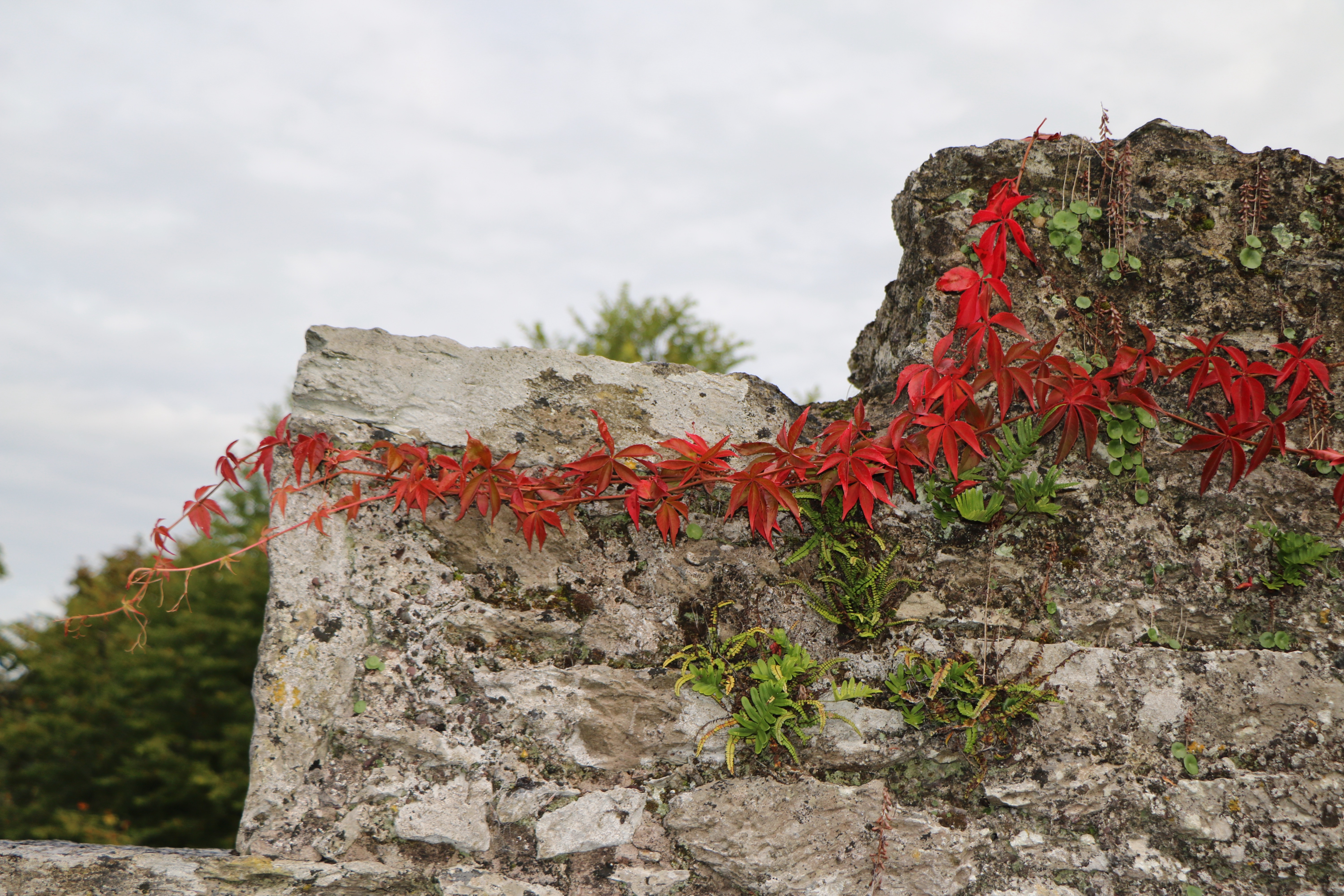
Some Autumn colors appear here.


Greg and I pass on the stone, but enjoy walking the gardens, including medicinal plants in the Poison Garden.  Several carnivorous plants too. Wooded area with caves with names like Druid's Place, Witch's Cave, etc.


We walk to the nearby Blarney Woolen Mills, for lunch and shopping.  The rain arrived during our lunch of egg salad sandwiches and chips (crisps). 


 Lots of traffic in this area as we head north.  We notice quite a few Aldi Grocery Stores, and several signs advertising caves and castles.   Our "surprise" stop is the  Rock of Cashel, also known as St. Patrick's Rock.  Built in the 12th century, it served as the seat of the Kings of Munster for several hundred years before the Norman invasion. Supposedly St. Patrick preached here and this is the most intact monestary in Ireland.


Next we head to Dublin, Europe's most popular vacation destination. We note there are no billboards on the major highways.  Also note very little police presence outside of cities.

We notice a few horses in pastures and David says that racing is very popular. Horse breeding is nationalized - government run!  He talks about the famous racehorse named Shergar that was kidnapped in 1983 and never heard of again after a ransom of 2 million pounds was demanded and refused. Some suspect the IRA.

Dublin was founded by Vikings 1,000 years ago, so is a relatively young city.  It was the seat of British power in Ireland until 1922. The River Liffey creates a port which is still active today.  Low Corporate taxes have attracted companies like Amazon, SalesForce and others to set up European hubs here.

We arrive at the Clayton Hotel and have a light dinner here.  Beth isn't feeling too well, so we pass on a walk around town. We'll have a tour tomorrow.

We've covered a lot of ground this trip, but David and GoAhead Tours have done a good job of breaking it up.  We've never gone more than 2 hours without a stop, and usually less.


Saturday, December 3, 2022

October 13, 2022 Kilarney, Slea Head, Dingle, Inch Beach, Gallarus Oratory


 Thursday, October 13

Nice breakfast at The Rose hotel in Tralee this morning as menus are given out and orders taken, rather than buffet.  They even offered waffles, which were small and seemed to have been dipped in sugar?  Took longer but a nice change. Nice rose garden!

We are heading to Killarney this morning, and pass a copper mine which is more than 5,000 years old, dating to the beginning of the Bronze Age!   This area had some of the first settlements in Ireland and is where farming began.   A little hazy early, but the sun soon breaks through.  Still chilly in the 50's.


We enter Killarney National Park for a jaunting tour in horse-drawn carriages. The drivers, called Jarvies, give a nice tour on the hour long ride.  Our driver was John and horse named Dolly.  Wrapped in blankets, it is a pleasant ride through trails with no other traffic. The area of the Park - some 26,000 acres - was donated by Arthur Vincent in 1932 for use as a park.   It includes the foothills of the MacGillycuddy's Reeks mountains, several lakes, woodlands, waterfalls and trails, as well as Ross Castle.


We see several red deer in the forest - this is the only place in Ireland where they roam freely - and end at the castle and Lough Lein.

The Park is at the beginning of the famous Ring of Kerry,  but instead of continuing on it, we opt for the Dingle Peninsula, an equally stunning trip with fewer tourists.   First we stop at a store called Mackenzies of Ireland for some "quality" shopping.  Thankfully we didn't do a lot of this on this tour. They did have lovely jewelry and knit goods, but best of all was the free Irish coffee offered while you shop!  I didn't think I would like it, as I'm not a coffee fan, but it didn't taste much like coffee actually and I liked it!

Next we passed through the town of Killorglin, with its statue of King Puck - a proud bronze billy goat.  Legend has it that this goat saved the town when Oliver Cromwell's English raiders were headed for Killorglin.  King Charles I was a "bad king" who sent his troops including Cromwell into Ireland to "convert" Catholics, but actually killed nearly 60% of the population!  (Charles was later beheaded.)The goat supposedly warned the citizens, who were then able to fortify their town and ward off the raiders.  They still have a yearly King Puck festival which, from what we heard, can be quite wild.

We head onto the Dingle Peninsula and Dingle Bay.  The bay, famous for shrimp and mussels, is bordered by sand bars with lots of rocks otherwise.  We stop at Inch Beach and walked a bit.  On the other side of the sand bar there is surfing where the Atlantic comes ashore.  The blue with white squiggles is the sign for the Wild Atlantic Way, a trail that follows the west coast of Ireland.


Around 12:30 the fog begins to roll in and visibility drops significantly.  When we reach the small port town of Dingle, a heavy rain arrives.  So we scurry from shop to shop and instead of lunch, Greg and I  opt for Murphy's Ice Cream, which we've been hearing about since Galway.  Very tasty and the young man there was quite pleasant. He said they are nearing the end of the season so he was happy for a little company, although they remain open year round while many shops will close.    I loved the zig-zaggy center line in the main street!


There is a statue of a Dolphin by the port and until a year ago, one named Fungie was famous in these parts, but alas he has vanished.


Next we travel on Slea Head Drive.  A very narrow road, most traffic knows it is one-way, but nothing is posted and occasional tourists make it interesting to pass.  


People have lived in this area for 7,000 years and there are many remains of ring forts, beehive huts also called clochan(dating to the 12th century) and stone walls.  Parts of Return of the Jedi were filmed here. There are remains, too, of many "famine houses", those abandoned during the famine and left to moulder.


We reach Dunmore Head, the westernmost part of Europe -  once thought "the end of the world" by many.  Beautiful, even in the fog.  Off shore is Blasket Islands,  no longer occupied after being destroyed repeatedly by storms.  And Ceann Sraithe, the very end of the Peninsula (David's favorite spot in all Ireland). 


Last stop is the Gallarus Oratory, an early 12th century chapel made entirely of sandstone, with no mortar. There is some disagreement as to its origins and purpose, but it is generally believed to be the oldest and best preserved church in Ireland.  We watch a short film and then hike up the hill to view it.

Nearly everything on Dingle Peninsula is built of stone.  Some of the stone walls here have a a crenelated top and a few have a layer of concrete on top to protect it from rain and weather.

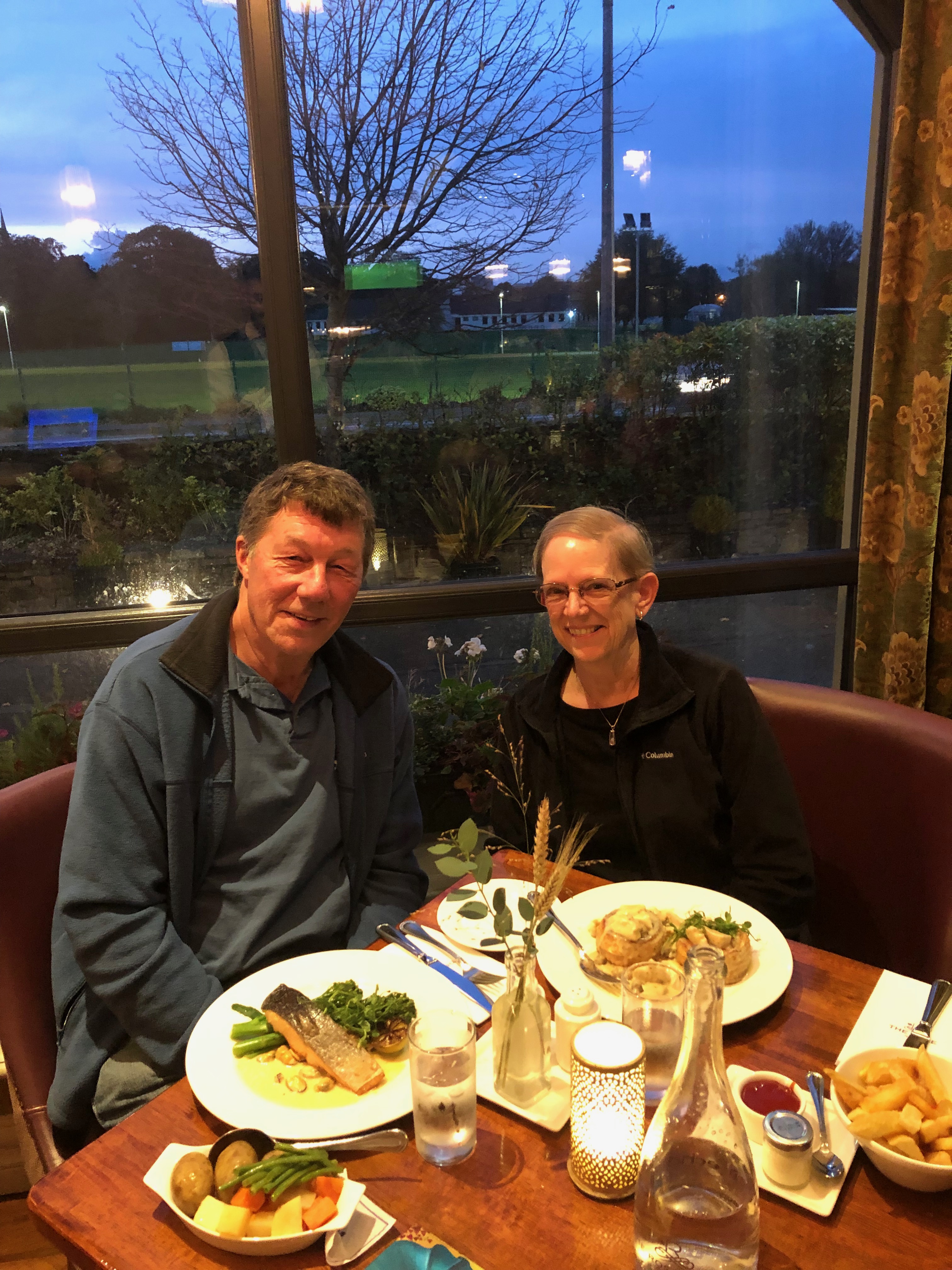
There are dozens of shades of green around here! We make reservations at the hotel restaurant for dinner and have a wonderful meal.  Beth has a chicken and mushroom pie with a salad and the ever-present chips (fries).  Greg has a shrimp and mussels combination in wine sauce.  Lovely restaurant is very busy, so glad we made reservations!