Search This Blog

Tuesday, January 21, 2014

January 18, 2014 SOUTH TEXAS: BULL FIGHT

January 18th, Saturday    South Texas Round 2

After having some electrical issues fixed, we headed south again to go to some of the spots we skipped a few weeks ago.  Weather is great, sunny and 50's, as we thread our way through Houston traffic and hit the open road of 59S.

Our first destination is a small town called Goliad which is outstanding in Texas History.  First stop is Mission Nuestra Senora Del Espiritu Santo de Zuniga - or Mission Espiritu Santo, established in the early 1700's when Spain was hoping to get a foothold in this new world (as was France).


 Mission Chapel
Baptismal Font

Many of the original "nail bosses" and other hardware remain.


A little further south is the Presidio La Bahia, built about the same time as the mission and meant to protect the mission as well as Spanish trade routes along the San Antonio River.  This fort continued in usage in the Spanish fight for independence, Mexican revolutions and then Texas fight for independence. Spanish, Mexican and Texan soldiers all garrisoned its walls.


During the Texas war for independence in 1836, Col. James Fannin and nearly 400 men under his command were captured and executed here by General Santa Anna , who fought a war of extermination - taking no prisoners.  This massacre fired the revolutionary spirit which resulted in capture and defeat of Santa Anna just a month or so later at San Jacinto.

Our Lady of Loreto chapel is the oldest building in the compound and has been in continuous use since the 1700's.

Many of Col. Fannin's men were held in this chapel at the presidio.  It is also the sight of Texas'  first declaration of Independence.  A memorial to Fanin and his men is nearby.

We next headed further south to Lake Corpus Christi State Park, arriving just before 5:00.  We found a nice site with hookups (wi-fi too!).  Saw several deer as we walked around the area.  This is a 21,000 acre reservoir which serves the Corpus Christi area (the city is about 30 miles away).


 Signs of civilization across the lake.
 Experimenting with some night photos and an almost-full moon.

We talked with neighboring campers from Minnesota, Nebraska, Iowa.  Lots of "Winter Texans".
One man was 88 years young and still going strong!


Sunday, January 19
Quiet night.  The morning was near 50 and a bit foggy with heavy dew.  We had breakfast and explored the park a bit before heading south again, towards LaGloria and today's bullfight.

 Many cardinals in the area.
 Early dew drops made for bejeweled spider webs.


 We spotted several crested caracaras along the road.

Pretty desolate roads with only a few small towns, (like Alice, Edna, Inez) and entrances to ranches.  Cattle is a huge industry.

Arrived in La Gloria about 1:00 and found the bullring owned and operated by Don Fred Rank.


Wandered around and watched some preparations for the upcoming event.  We could see some of the bulls and they were already feisty, kicking up dirt and looking like they were ready to charge.  There were alot of photographs and history of bull fighting.  The owner of the bullring also raises "brave bulls" (the bulls used in bullfighting).  Lineage is everything and breeding is done in only two places in the US.  There are still close to 1000 bull rings in the world, with the majority being in Spain and France, then Mexico and South America. They say the bulls get their bravery from the mother and nobility from the father.  These bulls will attack targets with little or no provocation.


 The matadors also have extensive training and experience.  Today we will see a Cesar Castaneda , world-ranked from Tijuana and Karla Santoyo an up-and-comer at 20 yrs. whose father and grandfather were world renowned matadors.

There is a 15 minute "Intro to Bullfighting" lesson with demo.

 It is quite choreographed with required elements and judges who award "ears" and "tails" to the matadors.   Once from the bull which was slain, they now use what we assume were artificial ones. Most of the moves are named after the matador who introduced them and some go back to Greek and Roman times. We are instructed in when to call "Ole" and how to express enthusiasm, as the judges are often swayed by the crowd.

Here are some shots of the action.  We saw 4 bulls over the next 2 hours, fought by 2 main matadors and a couple of "assistants" who distract or move the bull at times.  It was near 80 degrees.
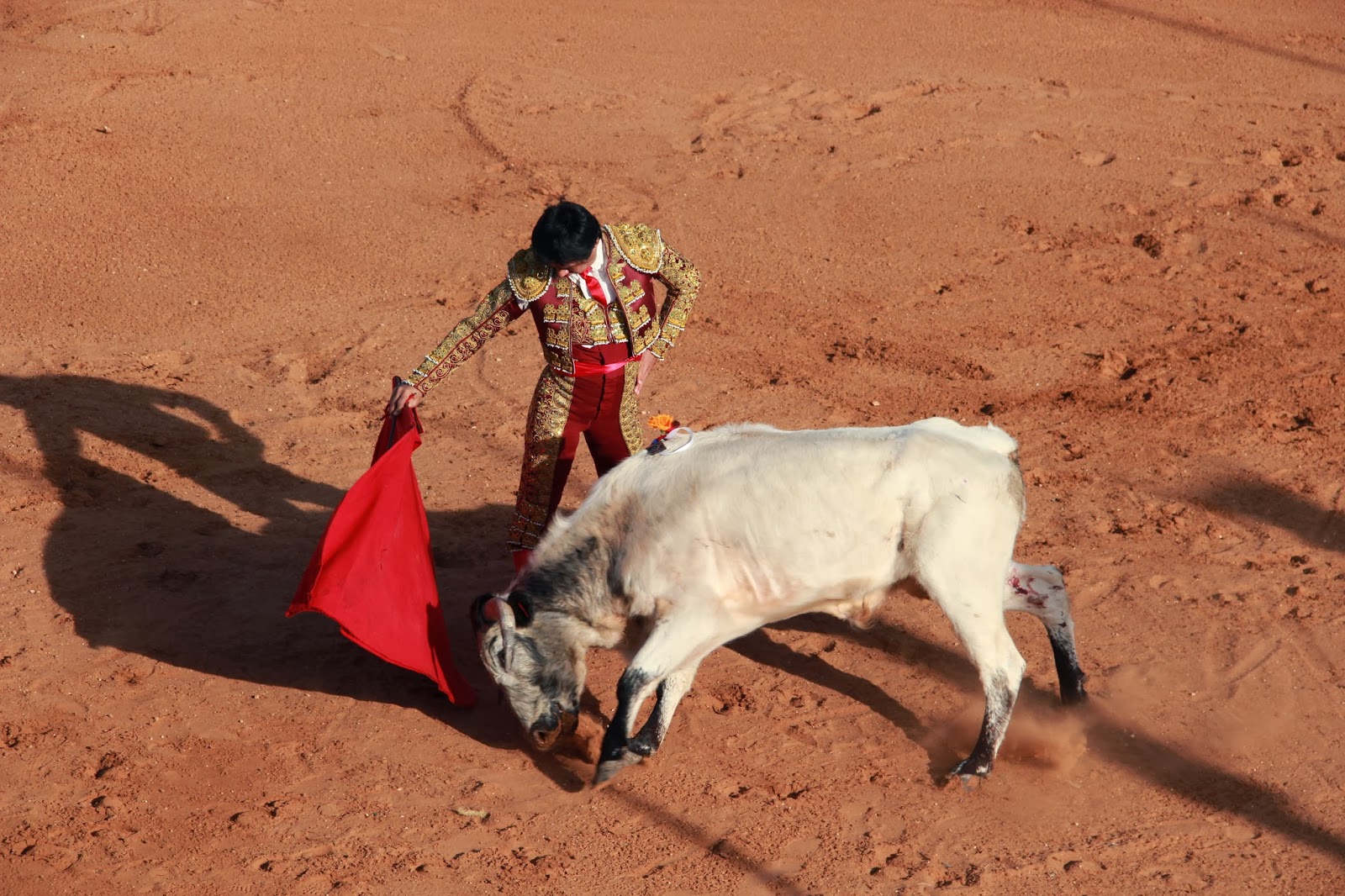
 You can see the flower with ribbons that the matador must grab after he has completed all the required elements.


 Showing bravery by turning his back and walking away.
 This bull was getting very close and eventually knocked the matador down.


The event ended about 6:00 and we drove for about an hour to a town called Edinburg, which is adjacent to McAllen.  Boondocked at a Walmart there, dinner, some photo work and reading.

Monday, January 20
55 degrees at 7:30 this morning.  We headed a little further south to Estero Llano Grande State Park, where we walked some trails and saw many varieties of ducks as well as pauraque, Chachalaca, hummingbirds and a few birds. This area is neotropical and there was lantana, citrus trees, bougainvillea, hibiscus and a few other flowers. Beautiful morning.

 Ducks and marshes.

Chachalacas - also nicknamed Mexican chickens.  Large, pheasant-like birds.

The land around here is mainly agricultural and we passed fields of broccoli, cabbage, lettuce, corn and squash.  Other fields were being prepared.   There is an intricate network of underground canals with concrete tower controls covering miles of the valley.


Had sandwiches for lunch and headed to Santa Ana National Wildlife Refuge, which is on the border with Mexico.  
 Walked several trails here which included a three observation towers and this hanging bridge which connected two of them.


spiral stairs to the tower. 

 Temps in the low 80's, as we walked a few miles.

 Saw several of these colorful green jays - with blue heads, green backs and yellow undersides, they are striking….noisy too but camouflaged well.  And speaking of noisy, there were many red-winged black birds making quite a racket.  Some other as yet to be identified birds like this one:

By mid-afternoon we decided we had walked enough and began the journey northwards.  We stopped at a small fruit stand where I bought 15 oranges, 2 grapefruits, a dozen tangerines and a couple of tomatoes - all for $4.00.

Back through the ranch land.  As we neared Victoria, we saw large herds of grazing deer.  We stopped at a Smokehouse for some bar-b-que, listened to some music and aimed for home.  We were past rush hour traffic in Houston so sailed through town, arriving home around 8:30.  Tomorrow we will unpack and get ready for Chap and Mam's visit, as they arrive Wednesday afternoon!

Sunday, December 29, 2013

DEC 27, 2013 POST-CHRISTMAS TEXAS COAST

Texas Coast Christmas 2013

12/27/13
After a fun Christmas with our sons, they headed back to their places and we packed the Trek. 
Left about 9:15 AM, 49 degrees, and headed down 288 toward the coast.  After we got out of the Houston area, past Alvin and southeast we began to see a few hawks, geese and a field of sandhill cranes. There are many fields used for growing rice and corn in this area, which attracts lots of birds.

 First stop was Brazosport Natural History Museum, next to the campus of Brazosport College in Clute (or Lake Jackson, there is some debate).  Named one of the ten best museums in Texas by Frommer’s Travel Guide, it was well worth the stop.  Most of the museum is dedicated to shells and the collection is immense, from all parts of the world.  Such beauty and variety in nature!


There were also interesting fossils, minerals and carvings, a huge butterfly collection and local archeological finds.  Many items were part of donated collections.  We had an interesting discussion with the man in charge, who is a shell collector and he passed along some information on Texas beaches, along with a handy map.

From here we headed further south and east to San Bernard National Wildlife Refuge on the coast.Saw thousands of geese here, along with red-tailed and white-tailed hawks, the ever-present turkey vultures and black vultures, coots (black & white ducks), doves, cardinals and other unidentified birds.   Along one trail we spotted an alligator (about 6’ long) who was about 10 feet away, down a small hill and up to his eyes in water.  We watched him and took a few photos till he raised himself up and gave a nasty hiss.  We got the message and quickly moved on!

  
Geese coming in for a landing….
Unfriendly gator.
Lovely trails with spanish moss.

On the way out of the refuge, two beautiful bobcats crossed the road ahead of us and disappeared into the brush.  Couldn’t get to the camera fast enough!

Next we headed down the coast to Matagorda Peninsula which is more like a barrier island. (Actually, Matagorda Island is a bit further south.)  There is a bridge over the Intercoastal Waterway which was quite busy with barges and such.  We arrived at  Matagorda Bay Nature Park about 4:30 and camped near their fishing pier and picnic area.  We walked out the pier , onto the jetty and back before firing up the generator and heating up some brisket and beans left from Christmas eve dinner.


Rough surf at Matagorda Nature Park.

Beautiful sunset.

Next morning we bundled up a bit (46 degrees and windy) and walked the beach.  There was quite a variety of shells, star fish and driftwood as well as some beautiful primroses, sea oats and grasses on the dunes.  I couldn’t resist collecting some shells.


long-beaked curlew.
Had breakfast and then headed south to Port Lavaca, a fairly sizable town, and then on to Aransas National Wildlife Refuge, through several tiny towns like Tivoli, Palacios and Austwell – barely more than a blink.

We had been to this refuge a few times before but usually just did the auto trail.  Today we tried the Heron Flats trail, Birding Trail and a few others.  Not a lot of animal activity, but it turned out to be a nice day with some sunshine and temps hit 62. Many people come here to see the Whooping Cranes. Texas has the largest population of wintering cranes of any of the states.  The population was down to 15 back in the 1940’s but has rebounded nicely up to 250.  We saw many great herons, which are almost as tall as whoopers (46” vs 52”), snow geese, white pelicans, curlews and other shore birds. But no whoopers L Saw a few deer, no javelina or gators, which we have seen in the past.  This refuge is very popular with birders and we did see many of them, binoculars and huge camera lenses in hand.


Great blue heron.
White tail deer.


Turkey vultures.


From here we continued south to Goose Island State Park, near the quaint town of Rockport.  We splurged on electric hook-ups, had a nice campfire and enjoyed a star-filled sky. Nice neighbors, couple new to camping, offered home-made clam chowder but we, unfortunately perhaps, had already eaten. We went to bed anticipating a steamy shower in the morning!
                                 Campground at Goose Island State Park.
12/29/13
Great hot shower in the morning and then we explored the park a bit. Lots of birds, including a roseate spoonbill and several egrets.


 There was a long fishing pier and several fishermen.  You could see many sizable sheepshead and occasional schools of other fish from the pier.  Several pelicans, both the larger white ones and brown ones were near the boat launch.


 Sheepshead
 Pelican

After leaving Goose Island, we joined several folks using computers at a McDonald's in Rockport and did some blogging while having lunch.  We continued south, through Corpus Christi and out to North Padre Island National Seashore.  After visiting the welcome center, we drove a few miles on the beach, and then headed to the campground at Malaquite Beach.

We walked the beach which had many birds, mostly willets, and very few shells.  Also several groups of sanderlings - those tiny hyperactive birds that run into and out of the surf.
 "Bully" willet kept chasing this one.


 George, quite photogenic heron. Stands about 40" tall.
Another heron on the dunes.

There were a couple of fishermen in waders, and one looked somewhat familiar because he had a great heron standing watch by him.  Turns out he is the same fisherman we saw several years ago on New Year's Eve (74 and going strong).  There was a heron with him then too, named George.  He said this was George, although a ranger confided later that there are "several Georges".

It was very windy and sprinkling a bit, so we tucked in, had dinner and read.  Greg was finishing a book on Genghis Khan and I was finishing "The Goldfinch".  Took a break and walked down to the beach in the dark - the surf thundered and a sprinkling of stars lit the night.


 12/30/13
 Next morning we went on a birding tour with a guide named Karen who volunteers here with husband Tom during Winter.  They are from Wisconsin.  She drove us to several different spots with marshes and ponds, and even onto the beach.  Very knowledgeable and we saw at least 20 different kinds of birds! Most were ducks(redheads, teals, shovelers…)and other water birds, but we did see Harrier and White Tail Hawks, a Caracara, Kildeer and some beautiful small yellow warblers.

reddish egret
crested caracara

After the tour, we headed further south, through Harlingen, to Port Isabel and South Padre Island. The rain that began this morning gathered momentum and continued through the night.  We decided it probably wouldn't be good to camp on the beach, so joined a few other campers at the Walmart in Port Isabel.  Bought a roasted chicken and some potato salad for dinner, and spent another evening talking and reading.

12/31/2013

Woke to a cold, windy day with on and off sprinkles of rain.  Not ideal for doing things outdoors.  We decided to tour the lighthouse, keeper's house and a few small museums and since they didn't open till 9:00 and 10:00, we looked for a spot for a leisurely breakfast. We stayed in Port Isabel rather than crossing the causeway to Padre Island (fancier, more touristy) and found a place that looked very busy.     Cash only, locals,  packed, good food and good prices! 


Next we tried to tour the lighthouse, but it was closed due to the weather - I guess they don't want anyone blowing off the top!  The keeper's house was open and gave some interesting history - built in 1840's, captured and re-captured during the civil war.  Don't think too much of this area when you read about the civil war but there was quite a bit of activity.  The final battle of the civil war was just west of here (Palo Alto) - after the Confederacy surrendered.


Port Isabel esplanade.

We've seen towns with painted bears, horses, groundhogs, cows - and now dolphins!

The museums featured a lot of information about the history of the area and famous local shipwrecks, mostly Spanish in the 1500-1700s.  There was also an interesting history channel film about treasure hunting.
 early nautical accessories including hour glass
pieces of eight

When we finished, it was still raining and the forecast looked pretty bleak - 40's and more rain - so we decided to cut things short and head for home.  At this point we were very near Brownsville (US) and Matamoros (Mexico) but not interested in going to Mexico with all the recent violent activity there.  There are quite a few parks and preserves in "the valley", a World Birding Center, citrus orchards, etc. but we decided to leave them for another trip.   We headed for home ( buoyed by a lot of CD's)  by a more direct route and arrived safely about 7 hours later.  The rain stopped about 2/3 of the way home but it looks like it will catch up with us in a day or two.

Happy New Year!!